
Personal Growth & Relational Dynamics
Learning to navigate deep, authentic love without compromising one's core self.
01
Mental frameworks
- Philosophy — the mental models and frameworks we use to see the world, gathered eclectically from stoicism, existentialism, ecological ethics, and contemplative traditions. Nobody has to pledge allegiance to one school; each idea earns its place by whether it actually holds up in practice. Over time we'll assemble the ways of thinking that help people grow.
- Psychological mapping — navigating attachment styles (secure, anxious, avoidant, disorganized) and recognizing defensive patterns, including fawning (appeasement as a trauma response — over-accommodating others to avoid conflict or rejection, often at the cost of one's own needs). Content here stays evidence-based and always cites the underlying research — the popularized shorthand version doesn't count.
- Power dynamics — auditing individual interactions to surface and dismantle subtle power imbalances, applying the Systems pillar's "power & social architecture" lens at the interpersonal scale.
Stanislav Grof's mapping of altered states and inner experience is one of the deeper wells the Philosophy module draws from.
Go deeper · StanislavGrof.comThe Way of the Psychonaut — Stanislav Grof's encyclopedia of inner journeys02
Sovereign relating
The ultimate goal: learning to navigate deep, authentic love without compromising one's core self. So much of this culture struggles right here — marriages fall apart, the divorce rate stays high, and the ground keeps shifting under us with a phone in every hand and the freedom to move anywhere. We don't claim to have the solution. But we believe in sovereignty, and we believe in the power and value of love, so we treat connection and autonomy as complementary rather than as the false choice between "losing yourself in love" and "staying guarded to stay safe."
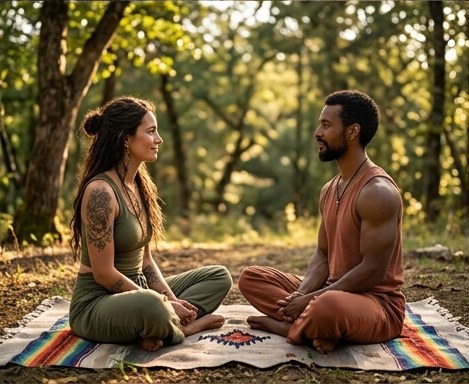
So the real questions are practical ones: how do we relate honestly, build trust consistently, and keep living alongside each other through difficulty and conflict? So many people end up living alone because navigating even a roommate relationship is hard — we need a culture, and a framework, for communicating through conflict and growing from it instead of exiling one another. Marshall Rosenberg's Nonviolent Communication is the clearest working toolkit anyone's built for this — naming needs and observations without blame, so honesty and connection stop being at odds. It's also where restorative justice enters: communities so often fracture around breakups and internal conflict, so sustaining one means learning to move through conflict together — which carries us straight into the Community section.
Go deeper · Center for Nonviolent CommunicationNonviolent Communication — Marshall Rosenberg / CNVC03
Stories of personal growth
A living library, still mostly empty: a place for Earth Warriors to post their own stories of personal growth, in their own words. Not polished advice — the actual, ongoing, sometimes-messy work of becoming someone you're proud of. Separate from the Mental Frameworks and Sovereign Relating content above — those are the models; this is the lived account of using them.