Physical Infrastructure & Sovereignty
Understanding how your electricity, water, food, and shelter actually work is the difference between being a dependent consumer and a sovereign participant.
We treat infrastructure literacy as a form of freedom. Understanding how your electricity, water, food, and shelter actually work is the difference between being a dependent consumer and a sovereign participant — and it's what lets you decide, honestly, what you're willing to take part in. If you knew the cheap shirt in your hands came from a sweatshop that hurt people, you'd know you didn't want it, whatever the few dollars saved. We seek to understand the larger systems so we can make choices we're proud of.
01
Real infrastructure logistical modules
- Electricity — generation, storage, and distribution basics; off-grid and hybrid systems; load calculation. Human infrastructure rewards this kind of literacy: once you see how a solar farm actually works, you spot the openings — like grazing sheep beneath the panels, the way William Harris does at White Oak Pastures in Bluffton, Georgia.
- Food & cooking — from soil to stove: growing systems, preservation, and kitchen infrastructure at both household and communal scale (the Academy's own Café draws directly on this module).
- Building systems — structural, thermal, and moisture design that's still paying off decades after the ribbon-cutting.
- Transit & mobility — vehicle maintenance, regional transit logistics, and the fleet-and-route thinking the Academy uses to move produce to farmer's markets.
02
Physical fabrication & forms
- Metallurgy — working knowledge of metals as a fabrication material: forging, welding, and material selection.
- Shack/shell structures — small, fast, low-cost buildable forms that grow real, hands-on competence — how to run a drill, do basic carpentry, even make a van livable — as an entry point to natural building.
- Geometry — octagons and EZ-pipe framing systems as efficient, teachable structural geometries that non-specialists can learn to build with.
03
The Earth has infrastructure too
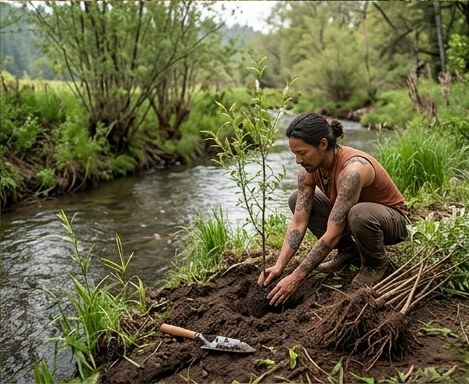
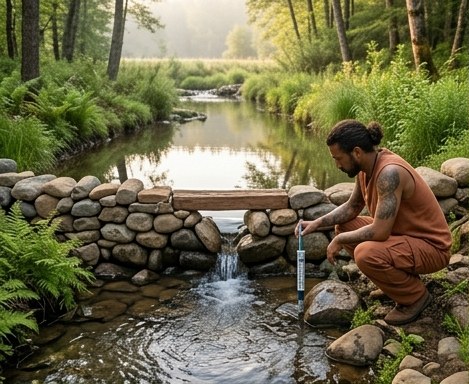
The Earth runs on infrastructure too, and understanding it gives us the chance to harmonize with it instead of blundering through it. So we learn hydrology, wind and ocean currents, thermal cycling, weather patterns, cloud formation, and solar cycles — along with the planet's other arteries, from river systems to the migratory paths of birds and whales. So much of this infrastructure is silent: we benefit from it every day but never built it, so we never had to understand it. Now we've grown large enough that our neglect of that understanding is starting to bite us.
EarthPulse is one Earth Warrior's answer to that — Rye Jupiter Seekins' work in earthworks and hydrological modeling, and a resource center for the rising tide of regenerative projects. Once you understand the water cycle you can become a positive participant in it: regreening deserts, keeping water in the landscape year-round, and softening floods. Springs are coming back to life all over the planet — that's the fruit of understanding the planet's infrastructure.